The History & Heritage of Château de Belet
A Veritatis Advisors Provenance Study of Château de Belet
The Birthplace of Alain de Solminihac
Veritatis Advisors · Saint-Aquilin, Dordogne · 2026
FOREWORD
History is usually written through the lives of remarkable individuals. Less often is it told through the places that shaped them. Yet places hold memory of their own. Long before names enter the written record, landscapes govern settlement, agriculture, defence, commerce and faith. Generations pass, buildings rise and fall, families prosper and disappear. The landscape endures. Château de Belet occupies one such landscape. Set on a ridge above the Salembre valley in what is today the Dordogne, the estate is more than a medieval residence or a noble family’s seat. Human interest in this ground reaches back to the Neolithic and can be demonstrated: a classified megalithic monument stands on the hill above the house, and the parish church in the valley below is a protected building in its own right. Between those two fixed points runs a documented tenure of more than five centuries — leases, testaments, marriage contracts, parish registers and cadastral plans — and, around it, a good deal that is remembered rather than recorded. This work has a single purpose: to set down, as faithfully as the present evidence allows, what is known of the birthplace of Alain de Solminihac. Born at Belet on 25 November 1593, Alain became one of the great reforming bishops of seventeenth-century France. As abbot of Chancelade and later bishop of Cahors his influence reached well beyond Périgord; he was declared venerable in 1927 and beatified in 1981.1 His life has been examined by theologians and historians, most fully by Patrick Petot, whose two volumes of 2009 draw on the ten thousand documents of the Fonds Solminihac at Cahors.2 The place where his life began has received comparatively little attention. The study was undertaken by Veritatis Advisors, and its occasion should be stated at the outset. The present owners are restoring and redeveloping the estate, and a commitment of that size ought to rest on something firmer than repute. What follows is the work of establishing, to a standard the reader can check, what the heritage of this place actually consists of: what the record shows, what is reported by others, and what is held locally and remembered rather than written down. The conclusions reached in Part Four — about what Belet should now be, and on what terms it should carry its own cost — follow from that evidence and are set out there plainly.
PART ONE — THE LANDSCAPE AND THE HOUSE
CHAPTER ONE A Ridge Before History Long before Château de Belet existed, and long before the House of Solminihac established itself in Périgord, people were drawn to the high ground above the Salembre valley. Elevated ground overlooking a fertile valley offers visibility, defensibility, dependable water and productive land, and commands the natural routes through the countryside. The ridge on which Belet stands possesses each of these advantages, and the modern visitor — seeing woodland, cultivated fields and long horizons across the Périgord — is looking at the reason successive generations chose this ground long before the first stone of the château was laid. The proof of it stands on the hill above the house. The dolmen of Peyre-Brune occupies the wooded rise that dominates Château de Belet to the north-west, beside the forest track The ridge from the south, before the woods returned. The château and its outbuildings stand on the skyline at the edge of the great woods running towards Segonzac; the dolmen of Peyre-Brune lies among the trees beyond. Photographer and date unrecorded; in the possession of the authors.
running from the hamlet of Seyssac towards Segonzac, at some two hundred metres above sea level. It is a Neolithic burial monument: a chamber roughly 2.70 metres long, formed of six standing stones of ferruginous sandstone and siliceous limestone, oriented north-east to south-west beneath a capstone that has slipped a little over the millennia. The French state classified it as a monument historique by the list of 1889, and it belongs to the commune.3 It carries several names. Peyrebrune and Pierre-Brune are the commonest; Roque-Brune is recorded; and it is also known, in the country round about, as the dolmen de Bel(l)et.4 That last name should be stated plainly and then handled with care. It tells us that the monument sits on Belet’s hill and has long been called by Belet’s name. It does not tell us that the builders of the dolmen and the builders of the château had anything to do with one another, and no archaeological relationship between the two has been demonstrated. What is established, on the authority of the state’s own inventory, is that this particular piece of ground was chosen, used and held significant several thousand years before anyone thought of raising a house on it. The monument was noticed in print by F. Jouannet in 1828 and afterwards by L. Drouyn and by A. de Gourgues. In 1874 the Société historique et archéologique du Périgord excavated it, and Édouard Galy published the first full description in the report; flint axes, knives and arrowheads came out of it, together with ornaments, part of which passed into the collections of the Musée d’art et d’archéologie du Périgord at Périgueux.5 The country people tell a different story about the stones. They say the dolmen covers the grave of a war-leader who had married a fairy; that he was killed in battle; that she raised the stones over him where he fell, and laid a curse on anyone who should ever disturb them. The tale is worth setting down. It is the oldest thing anyone in this parish still says aloud about the oldest thing in it. Rome came to Aquitaine and reshaped its roads, its farming, its administration and its trade. Whether this particular hillside was occupied in that period is not known. Here the reader passes from the documented to the remembered, and should know it. It has long been said at Belet that a Roman observation point once stood on the high ground near the present entrance to the estate, and that stone from it was taken up and built into one of the château’s oldest towers. The authors have found no document, no excavation and no publication supporting this, and note that the reuse of dressed stone across many centuries is common enough in the Périgord that the observation, even if correct, would prove nothing by itself. The tradition is recorded here as tradition, and because it is the tradition of this house. To it belongs a second story, of more recent date and of a more solid kind. In the course of restoration work an iron point was recovered on the estate. It is held at Belet — and has been so described by those who have handled it — to be a Roman pilum, the heavy javelin carried by the legionary infantry. That is the best information presently available about the object, and it is offered to the reader on exactly those terms: the identification rests on local judgement, it has not been examined by any archaeologist, and no report exists. A weapon of that kind would be an unusual recovery on a rural site in this part of the Périgord, and corroded iron points of very different periods can resemble one another closely. Until it has been looked at by someone qualified to look at it, it is an iron point of uncertain date about which an interesting thing is said. Even were the identification confirmed, it would not establish a Roman post on this ground. Artefacts travel; they are lost, discarded, reused and turned up again by ploughs centuries later. What it would establish is Roman-period activity on or near the estate — a smaller claim, and a real one, and the authors would be glad of it. For the modern custodians of Belet the find carried a meaning apart from archaeology. Rather than adopt an invented heraldic device or a modern mark, they took the silhouette of the point as the emblem of the estate: a decision reflecting the view that the identity of Belet should come out of its own past rather than out of contemporary branding. The emblem is a statement of philosophy. It is not an archaeological conclusion, and it is not offered as one here. Rome receded. Kingdoms rose and fell. Forest advanced and retreated. New families settled the valley. The ridge remained.
CHAPTER TWO Names, Lands and Jurisdictions A reader who follows Alain de Solminihac through the older literature will meet Belet, Reyssidou, Bruc, Grignols and Saint-Aquilin, sometimes within a single sentence, and may reasonably wonder how many places are being described. The answer is that the Périgord of the sixteenth century organised itself by lordship rather than by postal address, and that the names moved. This short chapter sets out the frame, so that nothing later in the book need be explained twice. The jurisdiction. Saint-Aquilin lay within the châtellenie of Grignols, the great lordship held by the Talleyrand, and the affairs of the parish were transacted in that frame. Alain’s father, Jean de Solminihac, was vigier — the officer of local jurisdiction — of the châtellenie of Grignols, and the family had held the viguerie of Saint-Aquilin since at least the beginning of the sixteenth century.6 When an archivist or a chronicler locates the house “near Grignols,” it is this jurisdiction, and the nearest place of consequence, that is meant. The name Belet. Three fiefs and noble houses of the name existed in the sixteenth century in the diocese of Périgueux — at Auberoche, at Bruc de Grignols, and at Saint-Aquilin.7 The name came into the family by marriage: Marie de Belet, believed the daughter of Bertrand de Belet, donzel in Grignols, married Pons de Solminihac in 1451, bringing Belet, Reyssidou and other lands with her. Thereafter the Solminihac were seigneurs of both, and were styled indifferently of one or the other according to which title the act required. The house on this ridge. The château above the Salembre was called Reyssidou — Ressidou, Reycidoux, Reyssidou in the acts — and it is under that name that Marie de Belet made her will there in 1496 and her son Antoine his in 1521. In the course of the seventeenth century the name Belet displaced it, and by the marriage contract of 1697 the seigneur is styled “of Reyssidou and of Belet”; from that period, as the older study puts it, the name of Belet subsists alone.8 The house is one house throughout. Only the name changes. In this volume the estate is called Belet, as it has been called for three centuries. Where a document says Reyssidou, the text says so, and the reader may take the two as the same place.
CHAPTER THREE The Birth On 25 November 1593 a son was born at the château of Belet, in the parish of Saint-Aquilin, in the châtellenie of Grignols. He was the fourth child of Jean de Solminihac and Marguerite de Marqueyssac, and he was christened Alain — the day being the feast of Saint Alain, bishop of Lavaur in the seventh century, and also the feast of Saint Catherine.9 A manuscript note preserved in the diocesan archives of Cahors records that he came into the world on Saint Catherine’s day at about midnight, and that he was baptised at Saint-Aquilin; his godfather was his cousin Alain de Tricard, and his godmother Marie de Bourdeille, dame de la Roque Vigneyron.10 That note is the closest thing to an act of baptism the authors have found, and it is worth pausing on. It gives an hour, a set of godparents and a parish. Godparents are the detail that is hardest to invent and easiest to check, and their names carry the birth out of hagiography and into the ordinary business of a country parish: a cousin stands for the child, and a lady of the neighbourhood with him. In 1593 a child was carried to the font within a day or two of birth, in the parish where the household lay. The earliest sustained account of the life is that of Léonard Chastenet, prior of the regular canons of Notre-Dame at Cahors and Solminihac’s own vicar general, printed at Cahors by Jean Bonnet in 1663, four years after his subject’s death; Chastenet says he had the details from Alain’s own mouth.11 Where that note now is can be stated precisely. Durieux consulted it at the bishopric in the nineteen-thirties. In April 2015 the whole body of papers known as the fonds Solminihac — nearly ten thousand pieces in seventy-nine bundles — passed from the diocesan archives of Cahors to the Archives départementales du Lot, and has since been classified: the archives of the episcopate in série G, articles 26 to 156; those of the canons regular of Saint Augustine at Cahors in série H, articles 173 to 364; and the diocesan archives of the nineteenth and twentieth centuries in sub-series 91 J. Among the last is a catalogue drawn up in 1847, attributed to the canon Vincent Antoine Albessard, of the pieces of the process of the venerable Alain de Solminihac which had never been classified by number and bundle — the process opened in 1783, and one for which a record of birth and baptism would have been required. A second and independent notice, drawn by the abbé Baudeau, formerly a regular canon of Chancelade, from the original titles, was consulted by Durieux at volume XVI of the Collection de Périgord. Both are traceable.12 The note is not the only thing that fixes the household in this parish; the family’s own acts do it for two centuries on either side of the birth. On 31 March 1456 Pons de Solminihac and Marie de Belet appear together as lords del Peyrus, de Beleto et de Ressido, granting holdings in the parish of Saint-Aquilin. Marie made her will in 1496 at the repaire of Ressidou, in the parish of Saint-Aquilin, and commended her soul to Saint Aquilin as her patron; her son Antoine, viguier of Saint-Aquilin, made his there in 1521. The family held the viguerie of the parish from the beginning of the sixteenth century, and Alain’s father sat as vigier of the châtellenie in which it lay. After the birth the registers of Saint-Aquilin carry the family’s baptisms, marriages and burials under the heading Belet for a further century and a half, and the house had a chapel of its own in which its daughters were married. The arms of Belet are carved on the keystone of the choir vault of the parish church itself. The household into which Alain de Solminihac was born was, on the evidence of its own instruments, a household of this parish.13 Alain was born into the closing months of the French Wars of Religion. Henry IV had abjured Protestantism at SaintDenis in July of that same year, four months before the birth; the peace was fragile, and reconstruction across Périgord would take a generation. The Solminihac were Catholic and had remained so throughout the conflict. Of the childhood itself the record says almost nothing, and this is unremarkable: noble families rarely wrote down the daily lives of young children unless something extraordinary obliged them to. What can be described is the world around that childhood, and here the estate and the parish are the evidence. Belet in the late sixteenth century was a working seigneurie, not a fortress and not a palace. It stood on high ground above the valley, at the edge of the great woods running towards Segonzac, commanding the surrounding country while remaining bound to the agricultural communities that sustained it. The seasons set the work. Tenants cultivated the land under leases the family had been granting for a century and a half; craftsmen kept the buildings; the household carried obligations reaching well beyond its own walls, and its head sat as vigier over the affairs of his neighbours. The château was at once a residence and the administrative centre of the estate around it. Chastenet adds that Alain remained in his father’s house until he was twenty-two.14 Faith was inseparable from that order, and here the record deserves to be set out exactly, because it is more interesting than the short version. The parish church of Saint-Aquilin is not dedicated to Saint Aquilinus. It is the église Saint-Eutrope, dedicated to Eutropius of Saintes, and it is a protected building: the church in its entirety was inscribed on the inventory of monuments historiques by order of 15 February 2007.15 The commune itself takes its name, it is said locally, from a hermit who was the companion and disciple of Saint Astier and who evangelised this district in the sixth century; the place appears in the twelfth century in the Latin form Sancti Aquilini, and Marie de Belet, making her will in 1496, commends her soul to Saint Aquilin as her patron.16 The building standing today is not the one this parish had in the twelfth century. Jean Secret, the archaeologist and historian of the Périgord, held that the present church succeeded an earlier Romanesque church nearby, which had probably suffered in the Hundred Years’ War and which an episcopal visitor found in ruins in 1688; rather than repair it, the parish had chosen to build afresh on new ground.17 The result is unusual for this district. Where most churches hereabouts are the outcome of a long and complicated architectural history, with Romanesque work surviving throughout, SaintEutrope can claim to belong in its entirety to the first Renaissance. It is rectangular and oriented, built wholly of dressed stone, with three chapels along the north side; the bays of the bell-tower, nave, choir and lateral chapels are vaulted with ribs and liernes; the floor is of terracotta and the glass is of the nineteenth century.18 Its great bell, Saint-Eutrope, was cast in 1701, and for three centuries the parish has gathered on the evenings of Advent to ring the peal by hand.19 So the church that received Alain de Solminihac in November 1593 was, in all likelihood, the present église SaintEutrope, then perhaps a century old — with the older Romanesque church, not yet fallen, still standing somewhere close by. Which of the two it was cannot at present be said, and this study does not pretend otherwise. The baptism is commemorated by a plaque in the church, which was restored in 2026.20 It is tempting, and it would be a mistake, to read the bishop backwards into the child. Character has many sources — family, education, faith, experience, conviction — and no estate makes a man. What can be said without straining the evidence is narrower and, perhaps, more interesting: the ridge above the Salembre was the first landscape Alain knew; the church in the valley below was his first place of worship; and the household at Belet, with its rhythm of season, obligation and account, was the first institution he ever saw administered.
CHAPTER FOUR The Family and the Seigneurie Alain was not the eldest son. That single fact governs everything that follows, and it is the reason a rural Périgord estate of modest standing appears at all in the history of the French Church. The Solminihac were minor nobility — petite noblesse rurale in the phrase the published accounts use — Catholic, rooted in the country west of Périgueux, of a rank that conferred obligation rather than wealth. Alain’s father, Jean de Solminihac, is styled in his marriage contract écuyer, seigneur de Belet, de Chaune and de Reyssidou — of the last only as co-seigneur with his brother Arnaud — and he settled five hundred livres on his wife upon the repaire and noble house of Belet.21 He was vigier of the châtellenie of Grignols. He married Marguerite de Marqueyssac at Bordeaux on 10 December 1579, and died in 1618.22 Their children included André, Jean, Raymond, Alain and Isabeau.23 The arms the family bore at Belet were not their own but their wives’. The Belet bore gules, three weasels argent, two and one — a canting device on the name — and the Solminihac stags; the two were formally joined by the maintenue of 1666. The Belet arms are cut on the keystone of the choir vault of the church of Saint-Aquilin.24 A family of this kind faced a familiar arithmetic. The estate passed to the eldest. Younger sons required a settlement that did not divide it — arms, the Church, or a marriage. Alain’s own inclination, by every account, was arms. He meant to become a knight of the Order of Saint John of Jerusalem, and his education prepared him for it; he rode well and handled a sword well, and until his late teens the Church formed no part of his intention. The sources disagree as to whether he was sixteen or eighteen when this was still his settled ambition, and the authors see no way to choose between them. Two things redirected him. The first is told rather than documented, though it is told by Chastenet, who had it from Alain, and repeated in every account since. Coming home one night from the country, he fell into the stream below the house; the current carried him a long way with his horse, and he came out unhurt. He understood his survival as the hand of God, and himself as preserved for some purpose.25 The story has the shape of hagiography and performs the function of hagiography. But it is the only surviving anecdote of Alain’s youth anchored to the ground around this house, and for a study of the birthplace that gives it a particular value. Whatever else it is, it is a story about a young man and the water below his father’s door. The second was structural, and it belongs to the family as much as to the Church. Alain’s uncle Arnaud de Solminihac, seigneur de Reyssidou, was the son of Jean I de Solminihac and Jeanne des Prez, and was born in 1543. Following the example of his own uncles Jean and Pierre des Prez, canons of Périgueux, he entered the Church; he was a doctor of theology and a canon of Saint-Front when King Henri III named him abbot of the ancient abbey of Chancelade.26 He was later vicar general of Périgueux. In 1613 he moved to pass the abbacy to a member of his own family, so that the benefice should not leave it.27 He designated his nephew.
PART TWO — THE LIFE THAT LEFT
CHAPTER FIVE Chancelade: A Ruined Abbey The abbey of Chancelade lies north-west of Périgueux, something over twenty kilometres from Belet — near enough that the abbey and the estate belonged to the same world. It had been founded in 1133 as a house of canons regular of Saint Augustine. By 1614 it was a ruin. The wars of religion had taken the abbey as they had taken so much else in the southwest: the buildings sacked and decaying, the revenues dispersed, the observance abandoned. The community that had once filled the church was down to three religious.28 It was, in the language of the period, a dead house — the shell of an institution whose name still carried a benefice. That benefice is the reason Alain de Solminihac became a churchman. Chancelade was held in commendam. Under this arrangement, widespread in France before the reforms of the seventeenth century, an abbey’s revenues were assigned to a holder who was not required to live in it, to have been professed in its order, or to take any care for its religious life. In practice, houses held in commendam decayed, and the system had become one of the chief instruments by which the wealth of the French Church was distributed among noble families. On 5 September 1614, at his uncle’s designation, Alain de Solminihac became abbot of Chancelade. He was twenty years old. He was not a priest, he was not professed, and he had never lived under a rule.29 It is essential to the honesty of this study to state that plainly, because Alain de Solminihac would spend the remaining forty-five years of his life fighting precisely this practice. As abbot and afterwards as bishop he made the residence of clergy, the fitness of appointees and the reform of benefices the central work of his career. The historian of the French episcopate meets him as one of the most severe critics of the abuses by which he had himself been advanced. The contradiction is not a blemish on the record. It is the record. A man who has been given something unearned may keep it, or he may become the person who ought to have received it. What follows is an account of the second course. He began with himself. He took the habit, submitted to the discipline he had been handed authority over, practised mental prayer, and made his religious profession on 28 July 1616 — nearly two years after his appointment. He was ordained priest in 1618. Only then did he go to Paris for some four years of advanced theological study, where he met François de Sales, moved in the circles of the devout, and formed the association with Vincent de Paul that lasted the rest of his life; the first letter between them to survive is of 1633, and the acquaintance was older than that.30 He received the abbatial blessing on 6 January 1623 and set about the spiritual and material recovery of the abbey.31 The programme was neither elaborate nor original. It was the ordinary observance of canons regular, applied without exception: attendance in choir, prayer at night, meals taken in common, and a common purse.32 The last mattered most. A community in which the religious hold private income is not a community, and the restoration of the common purse was the point at which Chancelade stopped being a benefice and became a house again. Within less than a decade the abbey had become the centre from which the canonial reform spread into the Saintonge, the Limousin and the Angoumois.33 That expansion ran against the design of the cardinal de La Rochefoucauld and of Charles Faure, who were turning the congregation of Sainte-Geneviève into a Congregation of France meant to gather every branch of the canonial order under one central authority. The two projects could not both prevail. Reputation of that kind did not stay local. Richelieu was looking for bishops of ability for a church badly served by the appointments of the previous century, and the reformer of Chancelade was noticed. Alain de Solminihac was named to the see of Cahors in 1636 — by every account against his own wish — and consecrated the following year; in the same year Urban VIII permitted him to hold abbey and bishopric together.34 He did not resign Chancelade. The house he had been given as a family arrangement he governed until his death. Twenty kilometres is not far. It is the distance from a father’s house to a ruined abbey, and it is also the whole distance between the life Alain expected and the life he had. He was born on a ridge above the Salembre in a family whose younger sons went to the wars. He would die at Mercuès as count-bishop of Cahors, having spent his career on the reform of a church that had made him at twenty the abbot of a house he had never entered.
CHAPTER SIX Cahors: The Reforming Bishop He was consecrated on 27 September 1637 in the church of Saint-Étienne-du-Mont in Paris, by Charles de Montchal, archbishop of Toulouse.35 He reached Quercy in the first days of February 1638 and installed himself at the château de Mercuès, the residence of the bishops of Cahors. The diocese was very large — it then reached as far as Montauban — and by the account preserved in the diocese itself comprised some eight hundred parishes, nine hundred priests, many of them ill-instructed, and three hundred religious, serving a population whose churches were often ruinous and unfurnished.36 These are orders of magnitude rather than a census. He began with a synod. It met on 21 April 1638, within weeks of his arrival, and was followed by a regular series until his death. From it came synodal statutes and an administrative structure built around vicaires forains, officers carrying the bishop’s authority into districts he could not reach in any given month. He formed an episcopal council. And he set about reconstituting the episcopal patrimony — obstinately, over years — on the unglamorous principle that reform without resources is exhortation.37 Then he began the visitation, and it did not end until he did. Episcopal visitation in seventeenth-century France was often a formality discharged by deputy. Solminihac travelled. It is said in the diocese, and repeated everywhere since, that over some twenty years he visited each of his eight hundred parishes nine times; the visitation records survive at Cahors and would settle the figure.38 Whatever the exact count, contemporaries called him an itinerant bishop, and the phrase described a method rather than a temperament — reform guided by what he had seen rather than by what he had been told. Two of his measures say more than the rest together. The first was linguistic. He required his clergy to preach in Occitan, the language actually spoken in the Quercy, and had a catechism printed in it.39 Instruction delivered in a language a district does not speak is not instruction. A bishop concerned chiefly with the appearance of order would not have troubled. The second was the seminary. In 1643 he founded one at Cahors and entrusted it to the priests of the Mission — Vincent de Paul’s congregation.40 The logic runs through his whole career: a diocese cannot be served by clergy it has not trained, and a reform that depends on the personal vigilance of one bishop dies with him. He also brought canons regular from Chancelade into the diocese, established them at Cahors, and sent them out to preach missions in the parishes. Alongside all this ran a programme of foundation that was material rather than devotional: houses for orphans and for the incurably sick, and the transfer and rebuilding of the hospital of Saint-Jacques, which became the general hospital of Cahors.41 When plague came into the diocese he stayed among his people. Of the revenues of his see he is reported to have said that they were the sacred patrimony of the poor and that all he might claim of them was his own bare living — a remark quoted throughout the Quercy, though the authors have not traced it to its source and do not print it here as his exact words.42 He was not universally admired. The reform met organised resistance: a syndicate of priests formed against his policy and contested it until the day he died. His pursuit of abuses and the stiffness of his character made him well-placed enemies, and it was the favour of the regent, Anne of Austria, that preserved him from disgrace.43 An account that left this out would be devotional literature rather than history. His influence reached well beyond the Quercy. As count of Cahors and baron of Quercy he held temporal authority and used it in support of the crown during the Fronde. He belonged to the Compagnie du Saint-Sacrement, remained bound to Vincent de Paul, defended the prerogatives of the Holy See against the Gallican current, worked for the condemnation of the Augustinus, and used what weight he had to secure the appointment of bishops answering to his own Tridentine standard.44 In October 1649 a conference of bishops — Cahors, Alet, Pamiers, Sarlat and Périgueux — met at his episcopal château of Mercuès.45 He designated as his coadjutor Nicolas de Sevin, bishop of Sarlat.
CHAPTER SEVEN Death, Memory and Recognition Alain de Solminihac died at the château de Mercuès on 31 December 1659, in the twenty-second year of his episcopate, worn out by the work. He left a diocese with a seminary, a written rule, an administrative structure, a trained clergy and a set of charitable foundations — and an abbey in the Périgord that had been three men and a ruin when it was handed to him at twenty. He also left a great deal of paper. The archives of the diocese of Cahors are among the best preserved in the French Church, and the Fonds Solminihac alone runs to some ten thousand documents.46 A pastoral letter of his on usury and interest was printed at Lyon in 1666.47 Reputations of this kind usually contract within a generation. His did not, and the reason is that it rested on things that could be checked. Four years after his death his vicar general published the life that remains the foundation of everything written since; it was reissued in 1817. Formal recognition came slowly, as it is meant to. The cause was introduced in 1783.48 In the 1920s Eugène Sol, the diocesan archivist of Cahors, took up the papers of the bishopric: a study of Solminihac and the Holy See appeared in 1927, and in 1930 a volume of letters and documents running to some seven hundred and fifty pages — a critical edition that put the man’s own words into the hands of historians, along with material on Gallicanism, on Jansenism, and on the state of the Quercy during the Fronde. 49 Solminihac was declared venerable by Pius XI in June 1927. He was beatified by John Paul II on 4 October 1981, the Pope commending him at the ceremony for his courage in evangelising the modern world without fear.50 His death-day, 31 December, is his feast; the liturgical commemoration is kept on 3 January. His reliquary, the work of the goldsmith Goudji, stands in a chapel of the cathedral of Cahors. Alain de Solminihac de Belet, 1593–1659, abbé de Chancelade, Scholarship resumed after a long interval. Patrick Petot’s two évêque de Cahors. Line engraving by Pierre Chenu (b. 1730), volumes of 2009, from a Limoges thesis of 2006, are the first full Cabinet des Estampes, Bibliothèque nationale de France. Although lettered Genuina effigies, the plate was cut more than a century after successor to Sol.51 The subject is not exhausted; the visitation the subject’s death and is not an authentic likeness; the quartered records alone would carry further study. Beatification did not arms it carries were an arbitrary combination made in the create the reputation. It confirmed what those who dealt with eighteenth century. him had concluded in his lifetime — including Vincent de Paul, who regarded him as a saint. The life that ended at Mercuès had begun sixty-six years earlier on a ridge above the Salembre, in the house of a family of minor rural nobility who had a younger son to place.
PART THREE — THE HOUSE AFTER
CHAPTER EIGHT The Descent of the Seigneurie The interest of this chapter is that it can be written at all. Most rural estates of this size have no continuous tenure on record; Belet has one, and it runs for more than five centuries, carried by testaments, leases, marriage contracts, parish registers and the cadastre. The Solminihac of this branch descend from Pons — also Ponce and Poncet — de Solminihac, damoiseau, second son of Raymond II, seigneur de Solminihac, and of Marguerite de La Roque. He is named in his father’s testament of 1415.52 He married Marie de Belet, dame de Belet en Grignols, de Reyssidou and other places, believed the daughter of Bertrand de Belet, donzel in Grignols, on the authority of a title of 1432; the family record gives the marriage as 8 August 1451 at Belet. The marriage contract itself, which must date from about 1450, has never been found.53
“Château de Bélet (Moyen Age) près Saint-Aquilin.” Printed view issued by the Librairie Fénelon, O. Domège, Périgueux, no. 1808. The farming household of the estate stands in the field before the west front, with the dovecote at the left; the registers of Saint-Aquilin name the families who worked this ground from 1737 onward. In the possession of the authors.
From that union the estate descends, and the acts begin to accumulate. Pons is witness to a marriage contract in 1446; grants the borie of Bonafous at fief in 1455; and on 31 March 1456 he and his wife appear together — Nobiles Poncius de Solminihac et Maria de Bellet, conjuges, domicelli de Granolhio, domini del Peyrus, de Beleto et de Ressido — granting the maynements of la Vaurière and la Feyrière, in the parish of Saint-Aquilin, to Pierre del Bosco. That instrument is the earliest reference to the fief under the name Beletum that the authors have seen. Further leases follow in April 1456 and in April 1461, the latter of the maynement of la Siboutie to Hélie Jalaye, merchant of Périgueux, before witnesses described as damoiseaux in Grignols.54 Pons made his testament on 20 March 1467, commending his children particularly to his lord and master Pierre de Grignols, founding masses in the chapels of Solminihac and of Grignols, and leaving rents to the Cordeliers of Sarlat, in whose chapel several of his forebears lay.55 Marie de Belet made hers at the repaire of Ressidou, in the parish of Saint-Aquilin, on 15 June 1496. It is the most valuable single document for the early history of this estate. She commends her soul to her patron Saint Aquilin and to Saint Front of the church of Bruc — the patrons of the parishes where her seigneuries lay — and asks to be buried in the ancestral tombs. She dowers her daughters. To her son Pierre she leaves domum meam nobilem de Beleto sitam in burgo de Sancti Aquilini, her noble house of Belet in the bourg of Saint-Aquilin, with her property on the right bank of the Isle; to Antoine, already possessed of the viguerie of Saint-Aquilin by an earlier act, she leaves the noble house of Reicidou.56 Her son Antoine, damoiseau, seigneur de Reyssidou, co-seigneur de Belet and viguier of Saint-Aquilin, received a feudal recognition on 19 August 1510 and made his own testament at Reyssidou on 4 March 1521, asking a hundred priests for his burial at Bruc, and requiring his heirs to bear the name and arms of the house of Belet according to their mother’s wish. The clause, the older study observes drily, was followed only as to the arms.57 Through the seventeenth century the family is continuously visible in the registers of Saint-Aquilin, and the entries are headed Belet. Hélies de Solminihac, seigneur de Belet, married Marie de Chabans on 8 July 1662, bringing the Mas-Poitevin into the house. Marie de Solminihac was baptised at Belet in 1670 and Marguerite in 1671; Pierre de Solminihac was buried in 1689, Claude in 1691 and Charlotte, demoiselle du lieu de Belet, in January 1693.58 On 17 December 1697 Marie de Solminihac married Nicolas de Fayolle at Belet, with dispensation from the bishop of Périgueux; her father is styled in that contract seigneur de Reyssidou and de Belet. Hélies de Fayolle was baptised at Belet in January 1699. On 5 April 1701 Marguerite-Étiennette received the nuptial blessing in the chapel of Belet with Pierre de Brachet, chevalier, seigneur de la Nouaille; the contract followed in March 1703. Further marriages were celebrated in the chapel in 1731 and 1735.59 The chapel is worth marking. A seigneurial house with its own consecrated chapel does not send its family to the parish church for every rite, and the fact bears on more than one question in this book. From the end of the seventeenth century the name Belet stands alone. The château and its land, contiguous with that of Fayolle, were comprised in 1724 in the erection of Fayolle into a marquisate, and at the end of the eighteenth century served to endow several demoiselles de Fayolle, after partition with the Nation. The château fell to Marguerite, married to the baron de Saint-Saud, who sold it to the Chazotte family, from whom Dr Mauriac acquired it and summarily restored it so as to ensure its conservation. The métairie of the château went to Mme Duvaucelle, who left it to her nephew the comte Raoul de Fayolle, whose daughter Mme de Sigalas also sold it to Dr Mauriac; the mill below the château went to Mme de Gamanson and was sold to the Bonnet family. The seigneurie of la Vigerie had left the Solminihac at the end of the seventeenth century; its house was rebuilt at the beginning of the nineteenth by M. Boisseuil, and his heirs sold it to Dr Mauriac, who reconstituted the greater part of the old Solminihac possessions.60 Beneath the seigneurs, the registers show the working population of the estate with equal clarity. From 1737 to 1801 the Boissau — Boisseau, Boisseuil — family appears constantly at Belet: Jean baptised in January 1737 and buried the same month; Antoine buried in 1738 aged seven; Bertrande baptised in August 1738; marriages, baptisms and burials year after year through to Léonard Boisseuil, born at Belet, living at la Vigerie Haute, who married Jeanne Fourgeaud at Saint-Aquilin in Year IX of the Republic. A later Boisseuil met a violent end at la Vigerie Haute, attacked with his servant by seven naval deserters who had dined at the inn at Saint-Astier and come masked to the house; he survived two days.61 The nineteenth and twentieth centuries carried it on. Marguerite de Fayolle, married to the baron de Saint-Saud, sold to the Chazotte de Peypissot; from them Dr Charles Tamarelle-Mauriac acquired the château and summarily restored it, saving the walls and roofs. It passed by inheritance to his nephew Dr Gouyou-Beauchamp, and by partition to one of the latter’s daughters, Mme Henri Lafaye — years in which disputes between tenants and proprietors gave the neighbourhood something to talk about. M. Jean-Marie Anne then restored the house completely; the Solart family followed in 2000; and the present owners acquired the estate in 2019.62
CHAPTER NINE The Fabric: Reading the Building Documents say who held a house. The house itself says what was done to it, and the two accounts should be kept apart until they can be brought together deliberately. The fullest published reading of the fabric is that of the marquis de Fayolle, writing at the turn of the twentieth century. He describes the château as forming, despite the plainness of its construction, an important mass dominating the valley of the Salembre at the edge of the great woods extending towards Segonzac. It consists of two ranges of building separated by an interior court and joined by structures without character; one The east front under frost, before the modern restoration: ivy to the walls, the machicolated pavilions and the round tower with its range is flanked by two round towers, the other by two square mullioned window. Photographer and date unrecorded; in the pavilions crowned with machicolation. The pavilions, and the possession of the authors. modest façade they accompany, appeared to him to have been added in the seventeenth century to an older part which must originally have constituted the whole château, and whose round towers and mullioned windows seemed to him to date from the fifteenth or sixteenth century. He records further that a cellar had recently been discovered outside the present buildings and long blocked up, which he took as proof of a rebuilding of some antiquity.63 That reading can now be carried a good deal further, because the house has been looked at from below as well as from outside. Beneath the visible building lie cellars containing vestiges of the twelfth century — evidence of the antiquity of the site, which the acts call the repaire de Reyssidou, long before the fifteenth-century house rose on it. The building was set out in deliberate obedience to the slope of the hill, and the consequence is still felt inside: the internal stair serves the floors by half-levels rather than whole ones. The oldest range is flanked by its two circular towers of the fifteenth century; a second range of lodgings was attached to it, flanked by two square towers with machicolation. Within are Renaissance chimneypieces, the finest of them carrying a cut inscription — fait par moy Laviole l’an 1670 — which is the only dated legend so far reported in the fabric.64 Against the east façade stands a rectangular cellar, and the traces still legible on the The château from the west, with the circular dovecote standing apart wall at the left and the ploughed field before it. The elevation may be read against the phasing described by the marquis de Fayolle. In the above it The château and its enclosure on the Napoleonic cadastre, before the possession of the authors. allow alterations of the last two centuries: the block of the house at parcel the sup‐ 19, the long range and outbuildings to the north-east, the walled position of a structure destroyed in the course of later works. The court and the terrace above the valley. same feature has been examined from within. What are called locally the underground works of Belet are, properly, vaulted cellars on a second basement level; they seem subterranean because on the west side they are reached only by descending a further storey from the cellars above, and because more than half their floor is buried under fill, the way in being a low segmental vault which must be entered on hands and knees. The chamber measures ten metres by five. Where the fill has spared it, the vault stands 1.60 metres above the present floor. The entrance is at the south-west angle. On the east side is a vent, now blocked, which formerly communicated with the open air beneath a terrace; the flank of the hill being close on that side, it is not impossible that the room once looked out over the valley, in which case it would have had the character of a casemate. An opening in the north wall suggests a further extension under the filled terrace, and is likewise blocked.65 The dependencies belong to the reading as much as the house. Facing the entrance across the court stands a barn of the sixteenth century which has kept its original roof frame. To the west is the round dovecote of the seventeenth century, a considerable tower set before the house and a little to one side, so placed that it does not cut the view. Below on the Salembre stands the mill, long part of the estate and now in other hands, and beyond it the étang des Garennes, which is among the finest sites of the commune.66 Two lines of enquiry follow directly. The blocked vent and the blocked opening in the north wall are the same order of evidence as Fayolle’s obstructed cellar outside the buildings, and clearing and recording them — under proper supervision — would establish what stood on the east side before the terrace was made up. And the Laviole chimneypiece of 1670 gives a fixed point against which the seventeenth-century campaign, and the machicolated pavilions attributed to it, can be tested.
The modern cadastre of the same ground, the estate shaded: Bellet and the Moulin de Bellet on the Salembre, with Seyssac-Est to the west and Bonnet-Ouest to the north-east — the parcels, tracks and watercourse of a working seigneurie still legible in the plan.
What is not yet in hand is a measured survey and phasing report by an architect or archaeologist competent in the vernacular and seigneurial building of the Périgord. Until that exists, this chapter records the questions rather than the answers. One point of fact belongs here rather than elsewhere: Château de Belet is not itself a listed monument. The protected buildings of this commune are the dolmen of Peyre-Brune, classified in 1889, and the église Saint-Eutrope, inscribed in 2007. It has been the care of Belet’s owners, and not the protection of the state, that has kept it standing.
PART FOUR — CUSTODIANSHIP
CHAPTER TEN The Living Connection: Belet and Chancelade Most historic birthplaces are commemorative. A plaque is fixed; a room is shown; the institution the person went on to serve is somewhere else and has no particular reason to look back. Belet is an exception, and the exception is recent and continuing. The Abbey of Chancelade keeps up an active relationship with the estate where the abbot who restored it was born. The present abbot, with priests and members of the community, has come to Belet on a number of occasions. These form a pattern rather than a series of courtesies, and their sense is clear enough: the account of Chancelade’s recovery is incomplete without the place where the man who brought it about began. The estate has also been the setting for reli‐
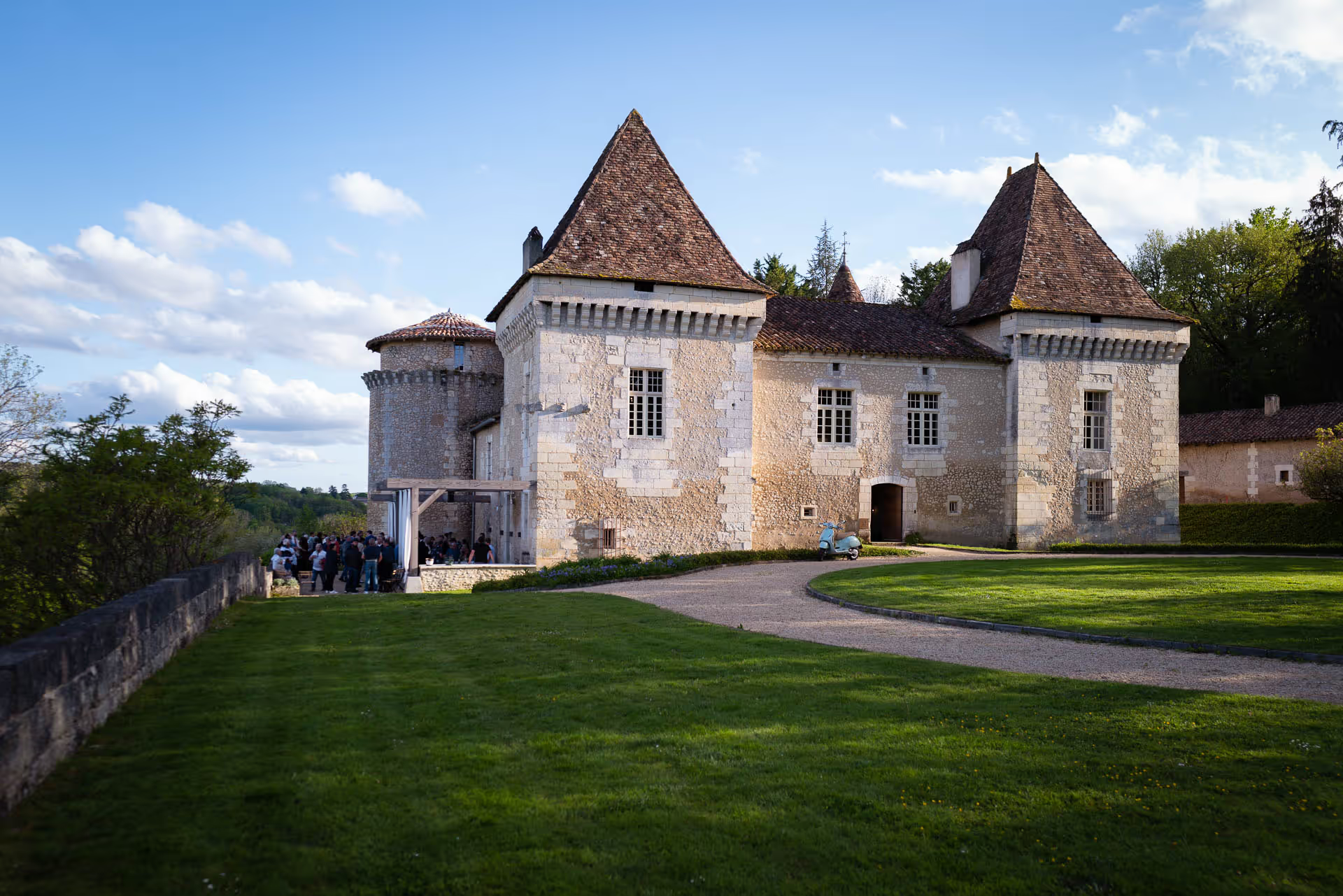
The same corner in 2026, the restoration concluded. The square pavilion carries its corbelled machicolation unbroken beneath a stone-tiled pyramid roof; the circular tower stands beyond it with its own corbel table. The ashlar quoins and the rubble panels between them, plainly legible here, are the surfaces on which any phasing of the building will have to be argued. Photograph in the possession of the authors.
The long range in 2026, seen from the garden below the terrace: the great round tower with its machicolated crown at one end, the mullioned windows of the older work, the lower tower at the other, and the retaining wall carrying the ground above the valley. Photograph in the possession of the authors.
gious gatherings, among them investiture ceremonies for French Scout groups under ecclesiastical leadership. Young people who know Alain de Solminihac, if at all, as a name in a diocesan history have made their promises on the ground where he was born. The family has come back too. A descendant bearing the Solminihac name, with his son, travelled from Brittany to Belet in recent years — some five centuries after Pons de Solminihac married Marie de Belet — and the authors record the visit as the emotional occasion it was. It is worth being clear about what this is and is not. It is not a survival from the seventeenth century, and no claim of unbroken observance at Belet is made here. It is a contemporary relationship, of recent decades, between an abbey, a family and a house. It is also, at the time of writing, the least documented material in this book — an irony worth acknowledging, since it is the only material the authors hold at first hand and the only material that exists nowhere else. Dates, officiants and the offices they held; programmes, orders of service and correspondence; photographs with their provenance recorded: all of this is being gathered into an estate archive while the people who took part can still confirm it. A letter from the abbey setting out the relationship and its history would be worth more than any of it, because a signed document travels with the house and outlasts whoever happens to own it.
CHAPTER ELEVEN A Philosophy of Living Heritage The ridge above the Salembre has been occupied, in one form or another, for several thousand years. That is the plainest fact in this study and, on reflection, the most instructive one. Nothing on this ground has survived by being left alone. The dolmen builders raised their stones on the hill above the house, and the state has protected the monument since 1889 because a community once had reason to build it. A seigneurial house rose below, was extended in one century and refaced in another, and had a cellar blocked and forgotten in between. A Romanesque church served the parish, was damaged in the long wars, and was replaced rather than repaired — the parish choosing to build afresh, and leaving the old church to the ruin in which a bishop’s visitor found it in 1688. That replacement still stands, and stands because it went on being needed; it is being restored again in our own time. Every element of the landscape described in these chapters exists because some generation found a use for it and paid the cost of keeping it. Buildings of this kind were not conceived as monuments. They were homes, farms, places of hospitality, employment, worship and administration. They were designed around occupation and they depend on it. A house that is lived in is heated, ventilated, watched and repaired; faults are noticed in the week they appear rather than the decade. A house left empty is none of these things, and the decline of an unoccupied historic building is not slow. It is a matter of a few winters.
The same ground in our own time: the château on its ridge above the Salembre, the round towers and the machicolated pavilion, the long barn range to the west, the terrace and pool set below the retaining wall, and the woods closing again on the hill where the dolmen stands. A house in use. Photograph in the possession of the authors.
The contrary position deserves to be stated, because it is held by serious people and it is not wrong. Adaptation is what destroys historic fabric: the removed partition, the inserted bathroom, the widened opening, the impermeable render that traps moisture in walls built to breathe. Almost all of that damage is done by owners acting in good faith. But the alternative to the occupied building is almost never the untouched building. It is the abandoned one, and abandonment is not a neutral holding state — it is an active process of loss. The question facing an estate of this scale is not whether it will be altered. It is whether the alteration will be informed. Two questions follow from this, and neither is answered by enthusiasm. The first is which places. Houses of this kind are not rare in the south-west; they stand in every valley, and there are more of them than there is money or will to keep. Some triage is inevitable, and it is better made deliberately than by neglect. The test that seems to hold is not size but capacity — whether a house can again carry a district. Belet could: it stood at the centre of forty-four hectares, with tenant farms, a mill on the Salembre, a barn, a dovecote and a chapel, and the registers name the families who worked that ground season after season for a century and a half. A house that once carried a community can be given that office again. A house that never carried one cannot, however handsome it is; and a great house standing where the village around it has gone will not bring the village back by being repaired. The judgement cuts both ways, which is what makes it a judgement: some large houses fail this test and some modest ones pass it. The second question is on what terms. A building of this scale has never been sustained by admiration, and it was never meant to be. The seigneurie lived on rents, on the mill, on the métairies, on the labour and produce of the ground around it — it earned its keep from the activity of its own district, and the acts printed in this book are largely the record of that earning. Nothing has changed in the requirement, only in the form. A house kept as an ornament, funded from elsewhere, is a house waiting on someone’s continued goodwill; a house that pays for its own roof is a house with a future. What that argues for is a measure rather than an absence. Hospitality was among the original functions of these buildings, listed here with farming, employment, worship and administration, and a limited hospitality returns the house to something it always did. Kept limited, it funds the roof, the mason and the woodsman, and it draws visitors into a district that has something to sell them. Taken further, it changes what the house is: a building given over wholly to commerce loses the household that made the case for keeping it, and the district around it becomes a servicing operation rather than a place where people live. The distinction is not sentimental. It is the difference between a house that has a family and a house that has a rota, and a visitor can tell within an hour which one he has come to. That is what authenticity means here — not a manner adopted for guests, but the ordinary evidence of a place still being lived in. The year-round part is the whole of it. A house occupied for three weeks in summer and shuttered for the rest supports almost nothing, and it teaches the district that the great house is a season rather than a neighbour. A house occupied through the winter calls on the mason in February, keeps the lane open, buys where it stands, and is present at whatever the parish is doing in the dark months. Communities are not restored by a good August. They are restored by ordinary continuity, which is the least photogenic and most consequential thing a custodian can supply. That much concerns fabric. The deeper lesson available on this ridge concerns something else. Alain de Solminihac is remembered as the man who rebuilt Chancelade. It is worth being exact about what he found there and what he did. He found almost nothing. The abbey had been wrecked in the wars of religion, its revenues dispersed, its observance abandoned, its community reduced to three religious. There was little enough fabric left to restore, and restoring it would have achieved nothing in any case: a repaired building with three men in it is not an abbey. What he restored first was the common life — choir, night prayer, meals in common, and a common purse, so that no religious held private income. Then formation: novices received, trained, professed, until within a decade the house had become the centre from which the canonial reform spread into three neighbouring provinces. The buildings followed, because there was finally a community with a reason to maintain them. The pattern held when the scale changed. A synod within weeks of his arrival in Quercy; synodal statutes and vicaires forains, giving a diocese an administration it had lacked; a seminary in 1643, because a diocese cannot be served by clergy it has not trained; canons sent out to preach missions; eight hundred parishes visited and revisited across twenty years. He required his priests to preach in Occitan and had a catechism printed in it, because instruction delivered in a language the district does not speak is not instruction. He built where the need was material — houses for orphans and the sick, and the rebuilding of Saint-Jacques into the general hospital of Cahors — and when plague came he stayed. None of it was uncontested. A syndicate of priests opposed his policy until the day he died, and it took the protection of a regent to keep him in his see. He was not a beloved figure who reformed by consent; he was an exacting one who reformed against resistance, and the record is more valuable for saying so. Set the whole career beside the abbey where it began and the shape is consistent. He did not restore buildings and hope that life would return to them. He restored the institutions by which people are formed and a district is enabled to look after itself — observance, training, administration, instruction in the local tongue, care for the sick and the orphaned — and the fabric followed as a consequence of there being someone to use it. Purpose first. Fabric second. Read as a whole, the career has four movements, and they are worth setting out plainly, because there is nothing in them peculiar to a seventeenth-century churchman. He inherited something diminished, and he had not earned it. Chancelade came to him at twenty by an arrangement between relatives, and what came with the title was three men and a roofless church. Almost everyone who takes charge of an old place begins in that position: holding something they did not build, did not deserve, and cannot yet understand, whose condition is the accumulated result of other people’s decisions. He began by learning what he had been given. Two years passed between the appointment and the profession, and four more in study before he came back to the Périgord. He did not arrive with a programme. He took the habit and lived under the rule before he attempted to impose it, and when he came to govern a diocese he governed it from the saddle, on the principle that a man should see a parish before he legislates for it. Understanding preceded intervention, and the interval was long. He restored the life before he restored the walls. Choir, night prayer, the common table, the common purse; then novices received and trained. Only afterwards did the buildings rise, and they rose because there was at last a community with a reason to keep them up. At Cahors the same order held: statutes, officers, a seminary, a catechism in the language of the district, hospitals and houses for orphans — the institutions by which a place looks after itself — and the fabric followed the purpose rather than preceding it. And he built so that the work would outlast him. The seminary is the proof of it. A reform resting on one man’s vigilance ends with that man; a reform that trains its own successors does not. He named a coadjutor, governed the abbey he had been given until the day he died, and left behind an institution rather than a reputation. No comparison of persons is intended, and none would be seemly. What is offered is a pattern, and the pattern is available to anyone. Whoever inherits a diminished place — a house, a farm, a parish, a district — meets the same four movements in the same order: something broken comes into your hands unearned; you learn it before you touch it; you restore the purpose and let the fabric follow; and you build so that the next custodian inherits more choices than you did. The temptation at every stage is to reverse the order — to repair what is visible, quickly, and hope that life returns to it afterwards. It does not. That is the lesson of the abbey, and it is the reason a ruin twenty kilometres from here is a working house today while a good many handsomer buildings are not. That order of priority is not a religious insight, though a churchman demonstrated it. It is the condition on which places of this kind have always survived, and it is visible in every chapter of this book. The dolmen stands because a community had reason to raise it, and is protected because a later one had reason to keep it. Belet endured as a working seigneurie for five centuries — leases granted, tenants installed, mills and métairies worked, a chapel used, children baptised and buried under the name of the house — not as an object of admiration but as a place where things were done. SaintEutrope survives because a parish went on needing it. Chancelade stands today because a young man born on this ridge gave it back a common life.
The position adopted at Belet The provenance set out in the preceding chapters is not an ornament to the redevelopment of this estate. It determined it. Having reviewed the whole of what can be established about the bishop and about the house he was born in — the documented tenure of five centuries, the birth and the parish, the protected monuments standing above and below the house, and the relationship the Abbey of Chancelade has kept up with this ground in our own decade — the present owners concluded that a heritage of that weight sets the terms on which the place may reasonably be held, and settled the position and the market presentation of the estate accordingly. Belet is held, and is presented, as a private family estate first. That is the primary fact about it, and it is meant to remain the primary fact: a household in year-round occupation, with the ordinary rhythm of maintenance, season and parish that has kept the house standing through every earlier tenure. Everything else is secondary and is deliberately kept so. Secondarily, and within limits fixed in advance, the estate supports a measured commercial activity: private rentals of the house, guest experiences arranged around the estate and its history, and a small number of selective events. The purpose of that activity is defined and bounded. It exists to carry the cost of the redevelopment and the recurring cost of the fabric — the roof, the mason, the woodsman, the woods and the land — so that the house pays for itself rather than waiting on goodwill from elsewhere. It is not the identity of the place, and the volume is set at the level the household can absorb without becoming a rota. The heritage established in this study is what makes that position credible and what justified the investment. A birthplace of documented consequence, a continuous tenure carried by instruments that can be produced, a classified dolmen on the hill and an inscribed church in the valley, and a living connection to the abbey the bishop restored: these are not marketing assets but the actual substance of the place, and they are the reason a redevelopment of this scale on a building the state does not protect could be undertaken with reasonable assurance of what was being bought and what was being preserved. The order is the bishop’s order, and it is the order Belet now works by. Purpose first; fabric second; commerce in the service of both, and never in front of them. An estate is not a self-contained thing. It never was. It sat at the centre of a parish, a set of trades, a household and a congregation, and its condition and theirs were never separable. That is the arrangement this landscape held for a very long time, and the periods in which these places have fallen into decline are the periods in which that connection was broken. The inference is straightforward, and it belongs to whoever reads it. Historic estates do not survive because they are old. They survive because each generation decides, at some real cost, to give them a use — and to restore a great house without restoring its purpose is to repair a benefice and call it an abbey. Every inheritance of this kind carries an obligation easy to state and difficult to discharge: to understand the place before changing it, to change it as little as the present requires, to leave a record of what was done, and to hand it on in a condition that gives the next custodian more choices than one had oneself. The ridge will outlast all of it. It has outlasted a good deal already.
THIS STUDY AS A WORK PRODUCT
The work reproduced in this volume is an example of what Veritatis Advisors undertakes for clients before capital is committed, and it is set down here for that reason as well as for its own. A heritage estate is generally sold on its story. The particulars name a family, a century, a saint, a battle, an architect; the vendor repeats what he was told when he bought, and the agent repeats what the vendor tells him. Very little of that is dishonest and a good deal of it is inflated. What is remembered locally hardens into what is asserted in writing, and by the time a claim reaches an international buyer it has acquired the appearance of established fact without ever having been checked against a document. The buyer is then asked to pay for it, and afterwards to build a business case on it. A reasonable in-depth scan of the surviving record establishes what can actually be shown. The sources are not exotic, and they are the ones used throughout this book: the state’s inventories of protected monuments, the departmental archives, notarial minutes and parish registers, the Napoleonic and modern cadastre, the published monographs and the bulletins of the learned societies, and whatever survives in the diocesan or communal record. Applied to a specific set of claims about a specific property, that scan sorts them into what is established, what is reported by others and can be attributed, and what is held locally and remains unverified — and it does so before the price is agreed rather than after. The same discipline applies to protection status, where the commercial consequence is direct. A property may be described as listed when what is listed stands beside it, as here: Château de Belet is not itself protected, while the dolmen on the hill above it and the church in the valley below both are. Nor is protection one thing. Classification and inscription differ in what they cover — a whole building, a façade, a parcel, a setting — and they carry obligations as well as advantages. What matters to an investment is narrower than what matters to a historian: whether the protection reaches the parts of the fabric the project must touch, whether it constrains the work intended, whether the fiscal and grant regimes attached to it are in fact available to this buyer, this holding structure and this programme, and whether support available today can reasonably be relied upon to be available in ten years. None of that follows from the words on a listing. It has to be established case by case, and an old designation is not by itself evidence of validity, of return, or of future public support. Know what you are investing in before you invest. A review at this level is an indicative study — enough to test the claims on which a price and a business case rest, and to show where deeper archival or technical enquiry would be warranted before commitment — and it can be added to the Veritatis Estate Feasibility Study, undertaken in our capacity as the buyer’s Owner’s Representative. Belet is the case we know best, because we own it; what the reader holds is the same work, done for ourselves, and carried further than any transaction requires.
NOTES
1. Declared venerable by Pius XI, June 1927; beatified by John Paul II, 4 October 1981; the cause introduced in 1783. New Catholic Encyclopedia, s.v. “Solminihac, Alain de, Bl.”; diocese of Cahors.
2. Joseph Durieux, Monographie communale de Saint-Aquilin, in the Bulletin de la Société historique et archéologique du Périgord: three fiefs and noble houses of the name Belet are said to have existed in the sixteenth century in the diocese of Périgueux — at Auberoche, at Bruc de Grignols, and at Saint-Aquilin.
3. Patrick Petot, Alain de Solminihac (1593–1659), prélat réformateur: de l’abbaye de Chancelade à l’évêché de Cahors, Bibliotheca Victorina XXI, 2 vols (Turnhout: Brepols, 2009), from a thesis defended at Limoges in 2006. Reviewers record that it draws on some ten thousand documents of the Fonds Solminihac and prints 143 in annex.
4. Saint-Saud and Huet, genealogy of the Solminihac, with critical, historical and archaeological study by the marquis de Fayolle, pp. 174–175: the seigneur styles himself of Reyssidou and of Belet in the marriage contract of 10 December 1697, and from that period the name of Belet subsists alone.
5. Base Mérimée, ref. PA00082801, “Dolmen de Peyrebrune,” Saint-Aquilin: classified by the list of 1889; period, Protohistory; owner, the commune. Situation and description from the Mérimée record and from local heritage notices, which place the monument in the woods on the hill dominating the château de Belet to the north-west.
6. Durieux, Monographie communale, p. 364: fourth child of Jean de Solminihac and Marguerite de Marqueyssac; born at the château de Belet on 25 November 1593, the feast of Saint Alain, bishop of Lavaur in the seventh century. 10. Durieux, ibid., citing a manuscript note in the diocesan archives of Cahors: born on Saint Catherine’s day about midnight; baptised at Saint-Aquilin; godfather his cousin Alain de Tricard, godmother Marie de Bourdeille, dame de la Roque Vigneyron. The note itself has not been examined by the authors.
7. The alternative names, including dolmen de Bel(l)et, are recorded in the regional heritage literature. The earliest attestation of the Belet form has not been traced. 5. Reported in the regional literature; local accounts name Galy, de Lestrade, de Conti and Ernest Guiller in connection with the 1874 excavation. The report itself, in the bulletin of the Société historique et archéologique du Périgord, has not been consulted.
8. Léonard Chastenet, La Vie de Monseigneur Alain de Solminihac, evesque, baron et comte de Caors, et abbé regulier de Chancellade (Caors: Jean Bonnet, 1663), 8°, 825 pp., with engraved portrait; copies recorded in the Catalogue collectif de France; reissued Saint-Brieuc, 1817. Chastenet states that he had the details of the early life from Solminihac himself.
9. Jean de Solminihac’s office as vigier of the châtellenie of Grignols is given in the compiled genealogies and is consistent with the SaintSaud–Huet–Fayolle study; the family’s tenure of the viguerie of Saint-Aquilin from the early sixteenth century is documented at notes 56–57 below.
10. The transfer of the fonds Solminihac from the diocesan archives of Cahors to the Archives départementales du Lot in April 2015 — some ten thousand pieces in seventy-nine bundles — and its classification in séries G (articles 26–156), H (articles 173–364) and 91 J: Archives départementales du Lot, finding aid FRAD046_G_H_91J_AdeSolminihac, available in the reading room. The catalogue of unclassified pieces of the beatification process, attributed to the canon Vincent Antoine Albessard, is 91 J 6 (1847); the cause was opened in 1783. For the Baudeau notice, see Durieux, Monographie communale de Saint-Aquilin (Périgueux: Ribes, 1936), p. 364 n. 1: a note by the abbé Baudeau, formerly a regular canon of Chancelade, resting on the original titles, consulted by Durieux at volume XVI of the Collection de Périgord.
treated as an authentic iconographic document. It may be reproduced as a plate but must not be captioned as a likeness. 25. Chastenet, as quoted in Saint-Saud–Huet–Fayolle, p. 176: coming one night from the country, he fell into the stream, the speed of the water carrying him a long way with his horse, without his receiving any hurt. 26. Saint-Saud–Huet–Fayolle, p. 179: Arnaud de Solminihac, seigneur de Reyssidou, son of Jean I de Solminihac and Jeanne des Prez, born 1543; doctor of theology and canon of Saint-Front when Henri III named him abbot of Chancelade; his uncles Jean and Pierre des Prez were canons of Périgueux.
13. For the acts cited in this paragraph see notes 54, 56 and 57 below: the grant of 31 March 1456 in the parish of Saint-Aquilin; the testament of Marie de Belet at the repaire of Ressidou, parish of Saint-Aquilin, 15 June 1496; the testament of Antoine, viguier of Saint-Aquilin, at Reyssidou, 4 March 1521; and the transcribed entries of the registers of Saint-Aquilin headed Belet, 1662–1801, including the marriages celebrated in the chapel of Belet in 1701, 1731 and 1735.
14. Archives départementales du Lot, notice on Solminihac. 28. Abbaye de Chancelade. 29. Abbaye de Chancelade gives 5 September 1614 and his age as twenty; other accounts give twenty-one. 30. Profession 28 July 1616 (Abbaye de Chancelade); ordination 1618, four years of study at Paris, and the first surviving letter with Vincent de Paul in 1633 (DePaul University, Vincentian collections).
15. Chastenet, as reported in Saint-Saud–Huet–Fayolle, p. 176: Alain remained until the age of twenty-two in his father’s house.
16. Archives départementales du Lot: abbatial blessing, 6 January 1623.
17. Base Mérimée, ref. PA24000060, “Eglise Saint-Eutrope,” SaintAquilin: the church in its entirety (cad. AX 136) inscribed by order of 15 February 2007. A dossier of the Fondation du patrimoine gives 1980; the commune’s notice gives April 1980 for the inscription of the bourg on the inventory of picturesque sites, and the earlier date appears to belong to the site rather than the building.
18. Established by 1617. 33. Petot. 34. Named to Cahors 1636; papal permission to hold see and abbey together, 1637 (AD Lot). That he received the diocese unwillingly is stated by the diocese of Cahors. 35. Consecration at Saint-Étienne-du-Mont by Charles de Montchal, archbishop of Toulouse; the date corroborated by the New Catholic Encyclopedia.
19. Local heritage notices; and the testament of Marie de Belet, 1496, at note 56 below. 17. Jean Secret’s notice on the church, cited in the Fondation du patrimoine dossier and by La Sauvegarde de l’Art Français. The visitation record of 1688, if it survives in the diocesan archives of Périgueux, would be a document of the first importance for this study.
20. Diocese of Cahors. 37. Synod of 21 April 1638 and the series thereafter (Abbaye de Chancelade); synodal statutes, vicaires forains, episcopal council and the reconstitution of the episcopal patrimony (Petot).
21. Base Mérimée, PA24000060.
22. The figure recurs throughout the local and devotional literature; the visitation records survive at Cahors and are used by Petot.
23. Local heritage notices; the custom is maintained by Les Amis de Saint-Aquilin. Sources differ over the dates and weights of the two later bells, and none are given here.
24. Recorded in the accounts of his episcopate.
25. The plaque has been inspected by the authors; its date of installation, the body responsible and the basis on which it was erected have not been established. The restoration of the church has been the subject of a public subscription through the Fondation du patrimoine, whose dossier should be cited for the works and their dates.
26. Petot; Limoges thesis, 2006. Some accounts add that he was the first bishop in the kingdom to give effect to the Tridentine programme in this form; this has not been verified and is not asserted here. 41. As note 39. 42. Widely quoted in the regional literature; the wording and origin are not established, and it is not printed here as a quotation.
27. Saint-Saud–Huet–Fayolle, p. 176, from Jean de Solminihac’s marriage contract.
28. Petot; Limoges thesis; diocese of Cahors.
29. Compiled genealogies give the marriage at Bordeaux, 10 December 1579, and Jean’s death in 1618; the dates 1537–1618 and 1558–1627 for the parents appear in local heritage accounts.
30. Petot; Limoges thesis. The characterisation of him as strongly pro-papal in the Gallican conflicts and actively anti-Jansenist is that of the New Catholic Encyclopedia.
31. Compiled genealogies; Petot treats the family context at length.
32. Conférence tenue au château épiscopal de Mercuès … octobre 1649, par les … évêques de Cahors, d’Alet, de Pamiers, de Sarlat et de Périgueux, ed. with a preface by Mgr Laurent Camiade, bishop of Cahors (Cahors, 2018).
33. Saint-Saud–Huet–Fayolle, p. 171: the belettes of the Belet officially united to the stags of the Solminihac by the maintenue of 1666. The same page cautions that the quartered arms appearing on the eighteenth-century engraved portrait were an arbitrary combination made by the abbé Florent-Alain, and that the engraving — by Pierre Chenu, born 1730, died about 1800, and executed more than a century after Solminihac’s death — cannot be
34. Review of Petot, The Catholic Historical Review. 47. Lettre pastorale … touchant les usures et interests (Lyon: Claude Galbit, 1666). 48. New Catholic Encyclopedia.
35. Parish register transcripts as above; the contract of 16 March 1703 at Arch. dép. Dord., B. 858, per Saint-Saud–Huet–Fayolle.
36. Eugène Sol, Un prélat ultramontain du XVIIe siècle: Alain de Solminihac et le Saint-Siège (Aurillac, 1927); Alain de Solminihac, Lettres et documents, ed. E. Sol (Cahors: Delsaud, 1930), 751 pp., reviewed in the Revue d’histoire moderne et contemporaine, 1931.
37. Saint-Saud–Huet–Fayolle, pp. 174–175. 61. Parish and civil register transcripts in the authors’ possession; the account of the attack at la Vigerie Haute is credited to a prefect’s report, via the Société historique et archéologique du Périgord.
38. Acta Apostolicae Sedis 74 (1982), 261–63; L’Osservatore Romano, English edn, no. 41 (1981).
39. Local heritage accounts; and the authors’ own record.
40. Petot, 2009; the closing chapter, “La fabrication du saint,” is noted in the review in the Bibliothèque de l’École des chartes.
41. Saint-Saud–Huet–Fayolle, p. 175. 64. André-Jean Lacoste, summary of the history of the château de Belet, drawn on in the study of the cluzeaux of the Salembre valley cited at note 65; and the local architectural notice of the commune, for the twelfth-century vestiges in the cellars, the setting-out of the house on the slope with its half-level stair, the two circular towers of the fifteenth century and the attached range with two machicolated square towers, and the Renaissance chimneypieces including the inscription fait par moy Laviole l’an 1670.
42. Saint-Saud–Huet–Fayolle, pp. 30–31: testament of Raymond II, 1415. 53. Ibid., p. 31, on the title of 1432 and the missing contract; the date 8 August 1451 at Belet from the compiled family record. 54. Ibid., p. 31, citing F. Périg. 122 (Bideran); F. Périg. f. 2; and Arch. dép. Dord. E, F. Poumiès. The act of 31 March 1456 is quoted there in Latin.
43. “Les souterrains du château de Belet,” section K of the study of the anthropic underground works and cluzeaux of the Salembre valley in Périgord, with the measurements, the segmental vault at 1.60 m, the blocked vent on the east and the blocked opening in the north wall. The same study cites E. Garraud, Antiquités périgourdines, p. 102, and A.-J. Lacoste, pp. 282–287.
44. Ibid., p. 32, from the grosse among the Papiers de Solminihac. 56. Ibid., p. 32: testament of Marie de Belet, 15 June 1496, made at the repaire of Ressidou, parish of Saint-Aquilin, diocese of Périgueux, with extracts in Latin. Durieux, p. 364, summarises the same act. 57. Ibid., p. 33, citing Fonds-Latin 9143, f. 23, and the Papiers de Solminihac.
45. The barn of the sixteenth century retaining its original frame, the round dovecote of the seventeenth, the mill on the Salembre and the étang des Garennes: local architectural notice and the cluzeaux study. The Napoleonic cadastre and the modern plan reproduced here are in the possession of the authors.
46. Transcribed entries from the parish registers of Saint-Aquilin, headed Belet, in the authors’ possession; the marriage of Hélies de Solminihac and Marie de Chabans, 8 July 1662, also at Saint-Saud– Huet–Fayolle, p. 179.
SOURCES
Chastenet, Léonard. La Vie de Monseigneur Alain de Solminihac, evesque, baron et comte de Caors, et abbé regulier de Chancellade. Caors: Jean Bonnet, 1663. Reissued Saint-Brieuc, 1817.
Mazeau, Gabriel. “Alain de Solminihac,” in Cent portraits périgourdins. Périgueux: Société historique et archéologique du Périgord, 1980, p. 47.
Solminihac, Alain de. Lettre pastorale … touchant les usures et interests. Lyon: Claude Galbit, 1666.
Galy, Édouard. Report of the 1874 excavation of the dolmen of Peyre-Brune.
Conférence tenue au château épiscopal de Mercuès … octobre 1649. Ed. Mgr Laurent Camiade. Cahors, 2018.
Sol, Eugène. Un prélat ultramontain du XVIIe siècle: Alain de Solminihac et le Saint-Siège. Aurillac, 1927.
Saint-Saud, Aymard de, Paul Huet and Gérard de Fayolle. La famille et les origines du vénérable Alain de Solminihac. Généalogie. Étude critique, historique et archéologique. Paris, 1905. [Archives départementales du Lot, 2 226.] The principal source for the descent of the seigneurie and for the fabric of the château.
Solminihac, Alain de. Lettres et documents. Ed. E. Sol. Cahors: Delsaud, 1930.
Durieux, Joseph. Monographie communale de Saint-Aquilin. Périgueux: impr. Ribes, 1936; issued in parts in the Bulletin de la Société historique et archéologique du Périgord. Consulted via Gallica.
Valon, Abel de. Histoire d’Alain de Solminihac. Cahors, 1900.
Petot, Patrick. Alain de Solminihac (1593–1659), prélat réformateur. De l’abbaye de Chancelade à l’évêché de Cahors. 2 vols. Turnhout: Brepols, 2009. [AD Lot, 2 1474–1475.] Massabie, Bonaventure (vicar general of Cahors). Vie posthume du V. Alain de Solminiac, évêque, comte et baron de Cahors, d’après les documents originaux. Cahors, 1903. Massabie also left a body of papers gathered for a life he did not complete.
Genealogy of the de Solminihac family (Chilean branch), “Rama de Belet, 1415–1736.”
Mazeau, Gabriel. Alain de Solminihac. Périgueux, 1953.
Secret, Jean. Notice on the église Saint-Eutrope de Saint-Aquilin.
Lagane, Danièle. L’épiscopat d’Alain de Solminihac dans le diocèse de Cahors (1636–1659). Toulouse, 1974. [AD Lot, BR 1 597.]
Lacoste, André-Jean. Summary history of the château de Belet [pp. 282–287].
Séguy, J.-B. “Langue, religion et société: Alain de Solminihac et l’application de la Réforme tridentine dans le diocèse de Cahors (1637–1659).” Annales de l’Institut d’études occitanes, no. 1, 1977.
Garraud, E. Antiquités périgourdines. “Les souterrains anthropiques: les cluzeaux de la vallée du Salembre en Périgord,” section K, “Les souterrains du château de Belet.”
Cadurcen. beatificationis et canonizationis … Alani de Solminihac … positio super virtutibus. Sacred Congregation of Rites, 1914; Nova positio super virtutibus, 1917. The printed briefs of the cause, assembling the documentary evidence laid before the Congregation.
Archives départementales du Lot — fonds Solminihac (séries G 26– 156, H 173–364, 91 J); finding aid FRAD046_G_H_91J_AdeSolminihac.
Darricau, Raymond. Au cœur de l’histoire du Quercy: Alain de Solminihac, évêque de Cahors. Paris: C.L.D. Dumoulin, Christian. Alain de Solminihac. Annonay, 1983.
Archives of the diocese of Cahors — visitations, synodal statutes and correspondence, transferred to the Archives départementales du Lot in 2015.
Archives départementales de la Dordogne — parish and civil registers of Saint-Aquilin; série E; notarial minutes, série 3 E; cadastre napoléonien; série B.
Archives of the diocese of Périgueux — episcopal visitations, including 1688. Base Mérimée: PA00082801; PA24000060. Abbaye de Chancelade.
COLOPHON
This study was written at Château de Belet, Saint-Aquilin, Dordogne, and completed in 2026. It was prepared and is published by Veritatis Advisors. Don and Jennifer Macdonald are the owners of the estate and the principals of Veritatis Advisors. The restoration and redevelopment described in Part Four was undertaken by them between [dates]. Their interest in the subject is therefore direct, and the reader should weigh the contents accordingly; the apparatus is provided so that the reader may check them. The photographs and printed views reproduced here are in the possession of the authors; those of 2026 record the estate at the conclusion of the present restoration. The engraved portrait is from the Cabinet des Estampes, Bibliothèque nationale de France. The authors record their debt to the historians, archivists and members of the Solminihac family who supplied books, documents and photographs for this work, and who are named with their permission at [ ]. Veritatis Advisors™ and Château de Belet™ are trade marks of the authors’ undertakings. Dépôt légal / BnF · Archives départementales de la Dordogne · Société historique et archéologique du Périgord